FREQUENTLY ASKED QUESTIONSEverything You Need to Know About Adaptive Planning
Practical answers to the most common preparation and scheduling questions.
How does the AI Study Planner differ from a standard coaching timetable or Excel template?+
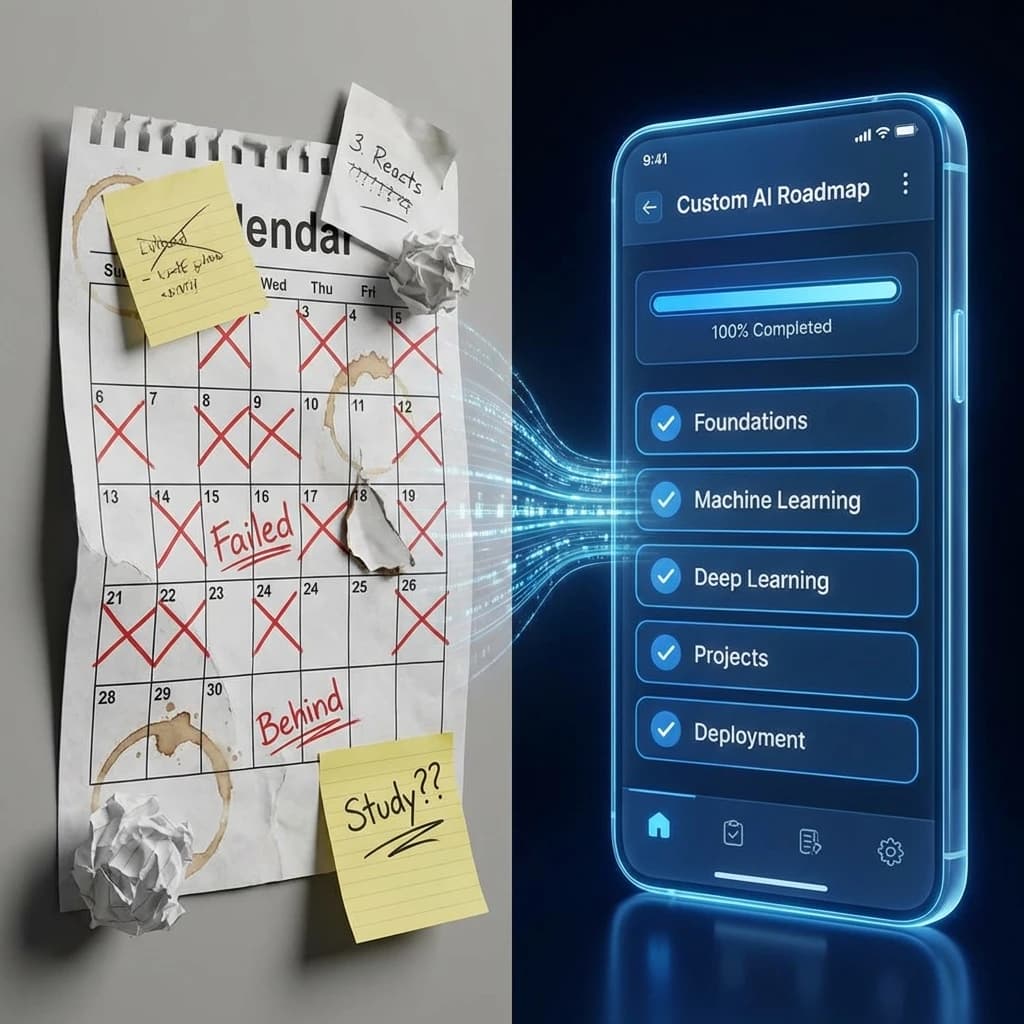
Standard coaching timetables and Excel spreadsheets are completely rigid and static. The moment you miss 2 days due to illness, workload, or family commitments, a static timetable permanently collapses and triggers study guilt. The UPSC AI Study Planner uses a dynamic slip-recovery algorithm that recalculates your topic velocity in real-time, redistributes backlog into weekend buffer slots, preserves high-yield milestones, and syncs directly to Google Calendar and WhatsApp.
Can working professionals with only 3 to 4 hours on weekdays use this planner effectively?+
Yes! Over 42% of our active users are working professionals. When you select the 'Working Professional' archetype, the planner configures an asymmetric weekday/weekend distribution: 3.5 focused hours on weekdays (morning static deep work, commute audio summaries, and night flashcards) combined with 8 to 9-hour weekend consolidation blocks for Optional subjects and mock test analysis.
How does the planner handle my Optional Subject and CSAT preparation?+
The planner allows you to select your specific Optional Subject (PSIR, Sociology, Geography, History, Anthropology, Public Administration, etc.) and automatically integrates Optional slots during Phase 1 and Phase 2. For CSAT, the AI implements a 'Qualifying Safety Gate' that schedules mandatory weekly arithmetic, reasoning, and reading comprehension drills so you never risk falling below the mandatory 66.67-mark qualifying cutoff.
What is the Ebbinghaus 1-3-7-30 Spaced Repetition Engine?+
Based on cognitive science, humans forget over 70% of new information within 48 hours without reinforcement. Whenever you mark a static chapter as complete, our engine automatically creates active recall checkpoints on Day 1, Day 3, Day 7, and Day 30. Instead of re-reading entire chapters, you receive targeted 10-minute micro-quizzes and flashcards to lock information into long-term memory permanently.
What happens when I miss study slots or fall behind on my schedule?+
You simply tap 'Report Delay' or let the automated 21:45 PM night check-in detect the backlog. The algorithm evaluates the missed topics against the 10-year PYQ weightage database. High-yield core topics are immediately reassigned to your upcoming weekend buffer slot, while peripheral topics are compressed into concise flashcards, ensuring your overall Prelims mock test schedule never shifts.
Does the planner synchronize with Google Calendar, Apple iCal, and WhatsApp?+
Yes. You can generate a 2-way Google Calendar or Apple iCal link that updates your daily study blocks automatically with phone alarms and reminders. Additionally, you can enable WhatsApp Daily Briefings to receive a 6:00 AM text and audio summary of your day's schedule and an evening 21:45 PM streak check.
When should I transition from Integrated Mains preparation to Prelims-exclusive mode?+
The planner automatically manages this transition based on your target year. Exactly 90 to 100 days before the UPSC Prelims exam (typically mid-February for a May Prelims), the planner transitions into 'Prelims War-Room Mode'—suspending Optional and Mains answer writing to dedicate 100% of study bandwidth to GS Paper I syllabus revisions, 10,000+ MCQs, full-length test simulations, and CSAT drills.
Is the UPSC Study Planner free to use?+
Yes! You can generate your customized UPSC study timetable, configure your aspirant persona, preview your 4-phase Gantt roadmap, and access the daily time-blocked schedule completely free. You can also export your schedule to PDF and sync it with your mobile calendar.
How does the planner map all 1,140+ micro-topics of the UPSC syllabus?+
Our academic team has broken down the official UPSC CSE syllabus into 1,140+ granular micro-topics across GS Papers 1 to 4, CSAT, Essay, and Optionals. Each micro-topic is mapped to standard reference books (Laxmikanth, Spectrum, NCERTs, Ramesh Singh, Shankar IAS/PMF IAS) and tagged by its 10-year PYQ frequency tier.
Can college students use this while managing semester exams?+
Absolutely. The 'College Student' profile features an automated 'Exam Shield Mode.' When college mid-terms or finals approach, you can activate the shield with one tap to reduce UPSC study hours to 45 minutes of essential flashcard retention, preventing semester academic stress while preserving your UPSC momentum.