6:00 AM INTELLIGENCE BRIEFING
10-Min ReadPIB + The Hindu + PRS + Yojana Synced

Daily UPSC Current Affairs in 10 Minutes — Pure Exam Signal

Stop wasting 3 hours on political gossip and unstructured newspaper reading. Every morning at 6:00 AM, get 6 essential topics with 5-point data briefs, Prelims trap flags, and instant Mains answer hooks.

Trusted by 2,50,000+ Daily Aspirants
★★★★★ 4.9/5 (9,876 Reviews)
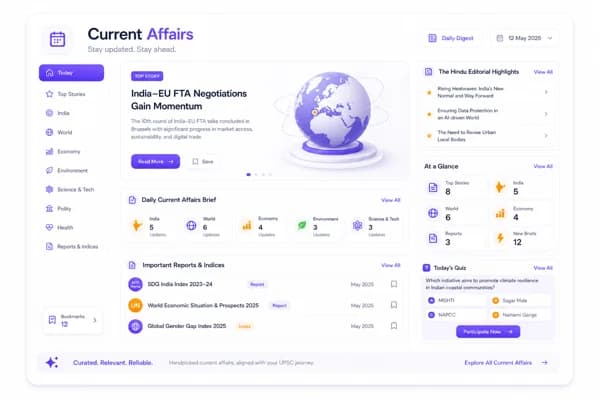
UPSC AI Daily Current Affairs Dashboard showing Top Stories, Hindu Editorial Highlights, Important Reports, and Daily Quiz

6:00 AM IST

Daily Publishing Time

10 Minutes

Average Daily Read Time

10,000+

PIB & PRS Releases Curated

+18 Marks

Average Prelims Score Boost

TODAY'S LIVE WIRE • 6 STORIES

Today's Essential UPSC Intelligence Briefs

Every topic is structured with a 5-point data brief, an explicit Prelims trap warning, and a Mains 150-word answer cue.

GS-II & GS-III • Lead Story6:00 AM IST

India-EU Free Trade Agreement: 10th Round & The CBAM Carbon Tariff Dispute

Negotiations in Brussels enter a crucial phase. The EU's Carbon Border Adjustment Mechanism (CBAM) threatens to impose 20-35% carbon levies on Indian steel and aluminum exports. India challenges this under WTO non-discrimination and UNFCCC CBDR-RC principles.

Prelims Trap Flag:

CBAM is an internal EU regulation, NOT a multilateral WTO treaty. Applies to iron, steel, cement, aluminum, electricity & hydrogen.

Mains Practice Prompt:

"Examine how unilateral environmental trade measures like CBAM impact developing economies in bilateral FTAs. (15M, 250W)"

PIB CommercePRS Policy TrackThe Hindu Editorial
Read Brief

GS-III • Agriculture & Economy6:00 AM IST

PM-PRANAM Scheme: Restoring Soil Fertility through Alternative Bio-Fertilizers

Cabinet approves state incentive allocations for reducing chemical fertilizer consumption. 50% of fertilizer subsidy savings will be passed to State Governments for organic farming infrastructure and green manure adoption.

Prelims Trap Flag:

PM-PRANAM has no separate budget; it is financed through savings in the existing chemical fertilizer subsidy managed by Ministry of Chemicals & Fertilizers.

Mains Practice Prompt:

"Discuss the fiscal and ecological rationale behind PM-PRANAM in curbing soil degradation in Green Revolution states. (10M, 150W)"

PIB Chemicals & FertilizersEconomic SurveyYojana
Read Brief
GS-II • Polity & Governance6:00 AM IST

Supreme Court Rulings on Article 200: Governor's Assent Timelines & Federalism

Bench clarifies that Governors cannot sit indefinitely on bills passed by state legislatures. If a Governor withholds assent, the bill must be returned 'as soon as possible' to the Assembly under the first proviso of Article 200.

Prelims Trap Flag:

Article 200 provides 4 courses of action: Assent, Withhold, Reserve for President (Art 201), or Return (except Money Bills).

Mains Practice Prompt:

"Critically examine whether gubernatorial discretion under Article 200 undermines democratic state autonomy. (15M, 250W)"

Supreme Court SCC 2023Law Commission 262ndIndian Express
Read Brief
GS-III • Environment & Ecology6:00 AM IST

3 New Ramsar Sites Designated in South India: Total Tally Reaches 85

Ministry of Environment designates 3 new wetlands under the Ramsar Convention on Wetlands of International Importance. Focus on community-led eco-tourism, migratory flyways (Central Asian Flyway), and wetland conservation.

Prelims Trap Flag:

India has the highest number of Ramsar sites in South Asia (85). Tamil Nadu holds the maximum number (16 sites) in India.

Mains Practice Prompt:

"Highlight the role of Ramsar wetland conservation in mitigating urban floods and supporting coastal livelihoods. (10M, 150W)"

PIB MoEFCCRamsar.orgDown to Earth
Read Brief
GS-III • Science & Space Tech6:00 AM IST

ISRO Gaganyaan TV-D2 Mission: In-Flight Crew Escape System Demonstration

ISRO prepares for the second test vehicle mission (TV-D2) to demonstrate crew module recovery and supersonic parachute deployment under abort conditions at Mach 1.2 altitude.

Prelims Trap Flag:

Gaganyaan will launch 3 crew members to a 400 km Low Earth Orbit (LEO) for a 3-day mission using the LVM3 rocket.

Mains Practice Prompt:

"Assess the geopolitical and technological significance of indigenous human spaceflight for India. (10M, 150W)"

ISRO Press ReleasePIB S&TSansad TV
Read Brief
GS-I & GS-II • Social Issues6:00 AM IST

NITI Aayog SDG India Index 2024-25: Poverty Reduction & Gender Equality Trends

National composite score improves to 67/100. Goal 1 (No Poverty) and Goal 6 (Clean Water) show highest gains, while Goal 5 (Gender Equality) continues to lag in female labor force participation (FLFPR).

Prelims Trap Flag:

NITI Aayog SDG India Index classifies states into: Aspirant (0-49), Performer (50-64), Front Runner (65-99), Achiever (100).

Mains Practice Prompt:

"Analyze the structural bottlenecks hindering India's progress on SDG Goal 5 (Gender Equality). (15M, 250W)"

NITI Aayog PortalUNDP ReportPRS Policy
Read Brief
THE 10-MINUTE METHOD

How We Eliminate 90% of Newspaper Fluff

Newspapers are written for general voters. Our 3-layer filtration engine extracts only what UPSC examiners can test in GS 1–4 and Essay.

LAYER 01

Syllabus Relevance Filter

Discards 90% of daily newspaper noise (crime reports, political mudslinging, local controversies) and extracts only events mapped to GS 1–4 syllabus keywords.

LAYER 02

5-Point Analytical Synthesis

Condenses complex 2,000-word policy papers into a 5-point exam brief: Context, Constitutional Link, Core Provisions, Critical Arguments, and Way Forward.

LAYER 03

Active Recall & Exam Hooks

Every topic is instantly paired with 2 Prelims MCQs to test distractor elimination and 1 Mains 150-word question for daily answer writing practice.

EXHAUSTIVE SOURCE COVERAGE

All Verified UPSC Sources in One Single Hub

We scan 10,000+ official portals, newspapers, and monthly journals so you never have to subscribe to multiple coaching magazines.

Official Record

Press Information Bureau (PIB)

Government Schemes & Cabinet

  • Cabinet approvals & fund outlays
  • Ministry-wise notifications & portals
  • Official statistics & policy launches
Synced Daily at 6:00 AM IST
Statutory Law

PRS Legislative Research

Parliament Bills & Committees

  • Bill clauses & constitutional scrutiny
  • Standing Committee recommendations
  • Law commission reforms
Updated per Session
Editorial Depth

The Hindu & Indian Express

National Editorial & Explained

  • Multi-perspective op-ed debates
  • Judicial critique & constitutional commentary
  • Bilateral geopolitics
Daily Morning Edition
Mains Essay & GS-III

Yojana & Kurukshetra

Development & Agrarian Themes

  • Rural livelihood & tribal welfare
  • Renewable energy & agro-zoning
  • Mains case study quotes
Monthly Synthesis
WORKFLOW EFFICIENCY

From 6:00 AM News to Mains Answer Mastery

Reading current affairs is useless if you cannot reproduce it under exam pressure. UPSC AI binds every single news brief to instant active recall drills.

6:00 AM — Read 10-Min Brief: Cover the 6 essential topics over morning tea with zero screen fatigue.
6:10 AM — Solve 2 MCQs: Immediately test whether you caught the examiner elimination traps.
6:20 AM — Write 150-Word Answer: Upload your handwritten answer for instant 60-second rubric evaluation.
UPSC AI Daily Current Affairs Workflow — From 6 AM News to Scorecard
MONTHLY COMPILATIONS

Download Free Monthly PDF Magazines

Released on the 1st of every month. 60 crisp pages organized by GS 1, GS 2, GS 3, GS 4 and Essay with revision tables.

August 202562 Pages

GS 1–4 Organized

Available 1 Sep

July 202558 Pages

Union Budget & Survey Special

Released 1 Aug

June 202560 Pages

Prelims 2025 Post-Exam Trends

Released 1 Jul

May 202564 Pages

Election Special & SC Rulings

Released 1 Jun

ASPIRANT REVIEWS

Loved by UPSC Aspirants Across India

4.9/5 from 9,876 verified reviews — how aspirants reclaim 70+ hours every month

Time Saving Routine

I used to spend 3 hours daily making notes from 2 newspapers. UPSC AI's 6 AM briefs gave me the exact 5 points and data hooks I needed in 10 minutes. That saved me over 70 hours a month, which I channeled directly into GS answer writing.

Prateek Mishra

UPSC Aspirant 2025

Verified
PIB & Economic Survey

The integration of PIB facts with Economic Survey data in the daily briefs is unmatched. Quoting scheme details and NITI Aayog points directly from the daily briefs improved my GS-III answer quality significantly.

Shalini Nair

UPSC Aspirant 2026

Verified
Active Recall Habit

Every morning's story comes with 2 practice MCQs and 1 Mains question hook. That active-recall habit ensured I never forgot key committee recommendations when writing practice answers.

Gaurav Joshi

UPSC Aspirant 2025

Verified
Prelims Trap Alerts

The 'Prelims Trap Flag' on each daily topic is a lifesaver. It doesn't just give you the news — it warns you how UPSC examiner traps invert administrative ministries or dates to trick you.

Akanksha Roy

UPSC Aspirant 2024

Verified
CURRENT AFFAIRS MASTERCLASS

How to Cover UPSC Current Affairs Without Drowning in Information Overload

Authored by UPSC AI Editorial Mentors • Updated for Civil Services Examination 2025/2026

1. The Myth of the 3-Hour Newspaper Routine

Aspirants frequently spend 2 to 3 hours reading every page of The Hindu or The Indian Express, copying long handwritten notes that they never revise. In the actual UPSC exam, Current Affairs is tested as constitutional anchors in Mains or specific elimination distractors in Prelims. Reading policy briefs for 10 minutes and spending the saved 2.5 hours on GS static subjects yields a 3x higher score delta.

2. The PIB-First vs Editorial-Second Principle

UPSC Prelims draws factual questions directly from official Press Information Bureau releases (cabinet approvals, scheme targets, nodal ministries). UPSC Mains draws analytical questions from editorial op-eds (policy trade-offs, federal friction, socio-economic impacts). Tagging news items as either "PIB Factual" or "Editorial Analytical" prevents cognitive confusion.

3. The Active Recall Rule: Never Read Passively

Always pair daily reading with immediate testing. Solving 2 Prelims MCQs and outlining 1 Mains 150-word answer immediately after reading locks the data into long-term memory.

Ready to test today's 6:00 AM intelligence briefing?

Read Today's Brief →
FAQ • 8 QUESTIONS

Frequently Asked Questions

Direct answers to everything about our 6 AM publishing, source coverage, and monthly magazines.

At what time is the Daily Current Affairs published every morning?

The daily intelligence briefing is published strictly at 6:00 AM IST every single morning, 365 days a year. It covers all PIB releases, parliamentary PRS briefs, and major national editorials published up to 5:00 AM IST.

How does this reduce newspaper reading time from 3 hours to 10 minutes?

A typical 16-page newspaper contains less than 15% UPSC syllabus-relevant material. Our editorial AI filters out political party rhetoric, crime reports, and sensationalism, distilling the remaining 5 to 6 high-yield topics into concise 5-point briefs that take under 2 minutes each to read.

Are the daily briefs useful for both Prelims and Mains?

Yes. Every single daily topic is bifurcated into: (1) Prelims Focus: Statutory bodies, ministry names, factual data, and 2 practice MCQs; and (2) Mains Focus: Constitutional articles, committee recommendations, counter-arguments, and 1 model 150-word answer prompt.

Is the Monthly Compilation PDF free to download?

Yes. On the 1st of every month, a comprehensive 60-page PDF magazine is released for free download. It organizes the entire month's developments by syllabus paper (GS-I, GS-II, GS-III, GS-IV, and Essay) with quick-revision comparison tables.

Can I test my retention on today's current affairs immediately?

Yes. Every daily brief is directly linked to the MCQ Practice Arena for instant 2-minute daily quizzes, and to the Mains Evaluation engine if you write the daily 150-word practice answer.

Which primary news sources and government portals are covered?

We systematically index: Press Information Bureau (PIB), PRS Legislative Research, The Hindu (Delhi Edition), The Indian Express (Explained & Editorial), Yojana, Kurukshetra, Rajya Sabha TV / Sansad TV debates, Economic Survey, Union Budget, and Supreme Court of India Law Reports.

Can I search past current affairs topics from earlier months or years?

Yes. All daily briefs are permanently cataloged in our syllabus-locked search engine. You can search any past scheme, summit, or judgment (e.g. 'India-EU FTA negotiations' or 'PM MITRA parks') to get instant summaries.

How does the platform prevent political bias in editorial summaries?

Our editorial engine follows the official UPSC constitutional objectivity code. Editorials are structured around constitutional balance (arguments for, arguments against, and an objective administrative 'Way Forward' citing NITI Aayog or Law Commission guidelines).

Need assistance? Reach our editorial desk at support@upsc.ai.

Start Today's 10-Minute Current Affairs Routine

Join 2,50,000+ aspirants reading 6:00 AM PIB & editorial intelligence briefs with zero political fluff.

✓ Updated Daily at 6:00 AM IST • 100% Free Access • Zero Ads