STAGE 01
Multi-Format Ingestion
Upload a smartphone photo or multi-page PDF. Vision models remove camera tilt, shadows, and wrinkles in under 3 seconds.
✓ Auto-Dewarp
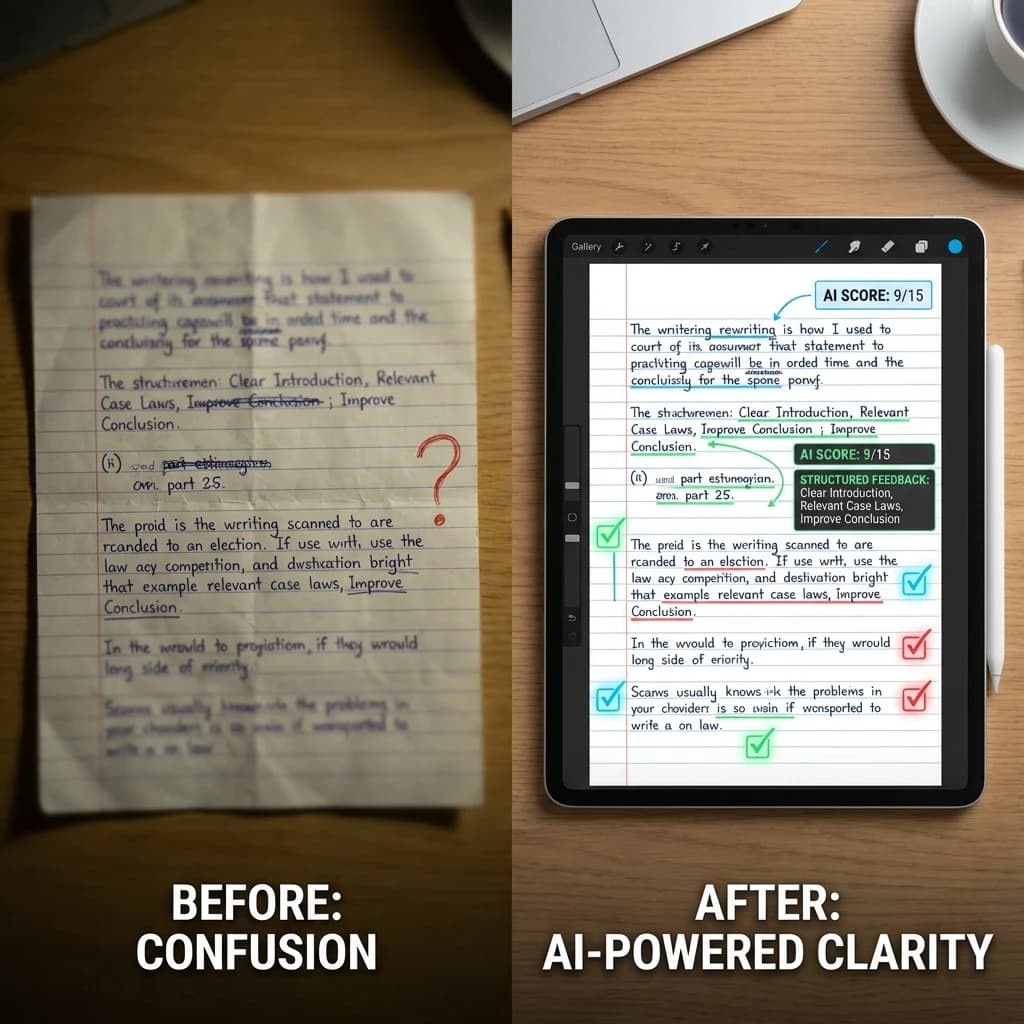
Upload a photo or PDF of your handwritten answer sheet. Get instant scores against the official 50-30-10-10 UPSC rubric, red-pen margin feedback, missing case laws, and topper benchmark models.
Upload Answer Sheet (PDF, JPG or PNG)
Supports Ruled Sheets, Plain Sheets & Multi-Page Copies
2,50,000+
Answer Copies Evaluated
48 Seconds
Average Turnaround Speed
98%
UPSC Rubric Correlation
+1.4 Marks
Average Score Gain in 30 Days
From raw PDF/photo upload to dense handwriting OCR, word count audits, and genuine red-pen margin overlays.
Upload a smartphone photo or multi-page PDF. Vision models remove camera tilt, shadows, and wrinkles in under 3 seconds.
Transcribes cursive and print handwriting line-by-line while verifying adherence to mandatory UPSC margin boundaries.
Counts exact word volume against the 150-word or 250-word ceiling. Flags verbose filler phrases and word bloat penalties.
Audits content against 12–15 syllabus keywords, constitutional articles, committee reports, and Supreme Court verdicts.
Renders red-ink margin notes, circled errors, strike-throughs on fluff, and sketches margin diagram suggestions directly on your copy.
Outputs 0–10 numerical scores across 4 pillars, paired with a side-by-side gap analysis against an AIR 23 Topper copy.
No more vague 2-line coaching remarks. Our multi-modal vision engine places red-pen callouts, underlines missing constitutional articles, and sketches custom diagram boxes right where they belong on the page.
Paragraph-Level Scoring With Exact Weightage
Every point audited against introductory hook, body arguments, counter-views, and conclusion.
Automatic Landmark Citation Detection
Flags missing Supreme Court verdicts, Law Commission reports, and NITI Aayog action agendas.
Word Limit and Question-Directness Audit
Evaluates adherence to directive words: "Critically Analyze", "Elucidate", "Examine".
Generic chatbots hallucinate fake Supreme Court cases and non-existent reports. Here is how our pipeline enforces strict factual grounding.
The AI is strictly locked to official supreme court law reports (SCC, AIR), PRS legislative bills, 2nd ARC reports, and NCERT databases. It never invents fake case laws or non-existent committee recommendations.
Calibrated across 2.5 lakh real evaluated copies graded by senior UPSC mentors and rankers, guaranteeing consistent 98% correlation with actual exam scoring benchmarks.
If poor handwriting makes a word ambiguous, the model highlights the exact segment as 'Illegible — rewrite clearly' rather than hallucinating words, helping students fix handwriting presentation leaks.
Unlike human coaching evaluators who suffer from grading fatigue after checking 10 copies, our neural rubric applies the exact same rigorous standard 24 hours a day with zero mood bias.
Evaluators grade under strict time constraints. Our AI audits your handwritten copy across the exact four dimensions examiners are instructed to score.
Audits whether all sub-directives (Discuss, Critically Examine, Evaluate) are satisfied with authentic constitutional articles, committee findings, and landmark Supreme Court verdicts.
12–15 must-have syllabus keywords verified
Constitutional articles & statutory provisions check
Empirical data & committee references (ARC, Sarkaria, Punchhi)
Evaluates the Introduction-Body-Conclusion architecture. Flags mono-block essay formats, verifies balanced arguments across both dimensions, and audits logical transitions.
Intro definition or contextual data hook (<25 words)
Bulleted sub-headings matching question sub-parts
Balanced 50:50 argument-counterargument proportion
Analyzes margin discipline, legibility, and keyword underlining. Suggests high-yield visual schematics, Venn models, maps, or institutional flowcharts to replace text blocks.
Handwriting legibility & margin compliance check
Underlining of core landmark cases & terms
Exact diagram recommendations (+0.5 marks)
Monitors adherence to strict word limits (150 or 250 words), eliminates filler adjectives, and enforces a constructive, constitutionally objective administrative stance.
Word count compliance (Flags >10% over-length)
Zero emotional bias or hyperbolic phrasing
Optimistic 'Way Forward' referencing government policy
Each paper requires a distinct evaluation lens — from GS-I historiography to GS-IV multi-stakeholder ethics crisis matrices.
Historiography, chronological timelines in Modern History, temple architecture terminology, demographic urbanization metrics, and geomorphological mechanisms.
"Contrast 19th-century Tribal Uprisings with the 1857 Revolt in character and ideology. (15M, 250W)"
Constitutional articles, Supreme Court ratios (Kesavananda, Bommai, Puttaswamy), statutory bodies, federal tensions, 2nd ARC, and geopolitical pacts.
"The Governor is a linchpin of federalism, yet recent conduct reveals friction. Critically examine. (15M, 250W)"
Union Budget metrics, Economic Survey themes, agro-climatic zoning, Ramsar policies, semiconductor missions, and multi-agency internal security doctrines.
"Why did the Green Revolution succeed in Punjab but lag in Eastern India? Analyze with BGREI. (15M, 250W)"
Ethical paradigms (Deontology, Teleology, Virtue Ethics), Nolan Principles, emotional intelligence, and 6-step stakeholder crisis resolution models.
"Case Study: Chemical plant leak involving local employment vs environmental safety. (20M, 300W)"
PESTLE multi-dimensional analysis, historical/literary anecdotes, thematic coherence, thesis hook, and structured 1,000–1,200 word flow.
"Wisdom finds truth in the clash of opinions — evaluate in modern democratic contexts. (125M, 1200W)"
Disciplinary scholars (Weber, Marx, Morgenthau), specialized theoretical frameworks, case studies, and discipline-specific terminology.
"Evaluate Gramsci's concept of Hegemony vs Althusser's Ideological State Apparatus. (20M)"
See exactly how your answer skeleton compares to an AIR 23 Ranker copy for the identical prompt.
4.9/5 from 8,734 verified reviews — real aspirants who mastered answer writing
“The generated red-pen margin markings are exceptionally thorough. It pointed out where I missed citing Article 200 assent timelines and suggested a clean 3-tier federal diagram. That immediate daily feedback transformed my answer structuring.”
Divya Aggarwal
UPSC Aspirant 2025
“The word limit audit caught me exceeding 250 words on almost every answer. Seeing the red-pen strike-throughs on redundant adjectives taught me crisp administrative drafting, saving me crucial minutes.”
Harshvardhan Patil
UPSC Aspirant 2026
“The handwriting OCR handled my cursive script perfectly without deforming lines, and the structural gap analysis showed me exactly where my introductions and conclusions needed stronger punch.”
Ritu Singhal
UPSC Aspirant 2024
“Uploading a phone photo and receiving a fully annotated copy with margin notes and 0-10 sub-scores in 60 seconds is unmatched. It completely eliminated the 14-day delay of traditional offline test series.”
Kunal Rathore
UPSC Aspirant 2025
Authored by UPSC AI Evaluation Mentors • Calibrated for CSE 2025/2026 Examination Patterns
Avoid generic dictionary definitions. Begin either with a constitutional article anchor (e.g., "Article 131 establishes original federal jurisdiction...") or an authoritative committee quote / baseline statistic. This immediately signals command of syllabus vocabulary to the examiner within the first 5 seconds.
Answers that score below 5/10 usually list 5 one-dimensional points. High-scoring Band 3 answers systematically cover at least 4 distinct dimensions: Political/Constitutional, Socio-Economic, Administrative/Procedural, and International/Comparative, with each paragraph led by a distinct underlined sub-heading.
Do not draw decorative diagrams that waste space. Use diagrams to condense 50 words of complex institutional interaction into a single 2-inch schematic (e.g., Venn diagrams for overlapping writ jurisdiction, or flowcharts for committee approval stages).
Ready to test your answer sheet against this exact Band-3 rubric?
Upload Handwritten Copy →Direct answers to everything about handwriting OCR, word limit audits, and red-pen margin markings.
Our multi-modal neural engine renders an interactive digital overlay directly over your scanned handwriting. It circles missing keywords, draws margin arrows with constitutional article citations, suggests diagram boxes, and highlights redundant sentences with red-pen examiner notes — identical to a physical copy checked by a senior evaluator.
Yes. You can upload multi-page PDF booklets (e.g. 10-question or 20-question full sectional tests) or individual smartphone photos. Our document pipeline automatically dewarps perspective angles, enhances lighting, and splits questions into distinct evaluation streams.
The OCR counts exact word volume against the 150-word (10-mark) or 250-word (15-mark) UPSC standard. It flags under-length answers that miss essential sub-parts and highlights verbose filler phrases if the answer exceeds the limit by more than 10%.
The evaluation pipeline is strictly grounded in authenticated primary sources: Supreme Court judgment archives (SCC/AIR), official 2nd ARC and Sarkaria reports, Union Budget datasets, and PIB releases. The AI is constrained by strict negative filters, meaning it will never invent non-existent case laws or committee recommendations.
Yes. The rubric adapts dynamically to GS Paper I, GS Paper II, GS Paper III, GS Paper IV (including Ethics Case Studies with stakeholder matrices), 1,200-word Essay papers, and major Optional Subjects (PSIR, Sociology, Geography, History, Public Administration).
Every registered student receives 2 full answer evaluations completely free with zero credit card required. Additional evaluations are available in affordable packs starting at ₹299 for 10 evaluations with unlimited rewrite delta tracking.
After inspecting your red-pen fixes, you can rewrite the same answer and re-upload it. The engine evaluates your updated version and calculates your 'Score Delta' (e.g. 6.5 → 8.8 / 10), confirming that your structural and content revisions successfully addressed the identified weaknesses.
Yes. All uploaded answer sheets, OCR transcriptions, and evaluation scorecards are encrypted and private to your account dashboard.
Need assistance? Reach our evaluation team at support@upsc.ai.
Evaluate Mains answers daily — pair with instant AI search and PYQ trend analysis.
Search any UPSC doubt and get exact NCERT page citations.
DailyPIB summaries and editorial analyses in 10 minutes.
24/7 AIInstant step-by-step doubt clearing with citations.
Prelims25,000+ adaptive Prelims questions with elimination logic.
Join 2,50,000+ aspirants improving their answer structure, case law density, and rubric scores every day.
✓ 2 Free Answer Evaluations • 60-Sec Result • No Credit Card Required